

"A letter always seemed to me like immortality"
Long live the connections that a mere stamp can sustain! 💌📫
A quick bit of housekeeping: School of Good Trouble will be on holiday break from now until after the new year. So, this is your last 2025 reminder: my new book is still on sale for a great price if you order direct from the publisher! The book would make a great "new year/new relationship to writing" gift for all the science and writing nerds in your life. Beyond that, I wish you the very best for the holidays--every one that you celebrate or navigate.
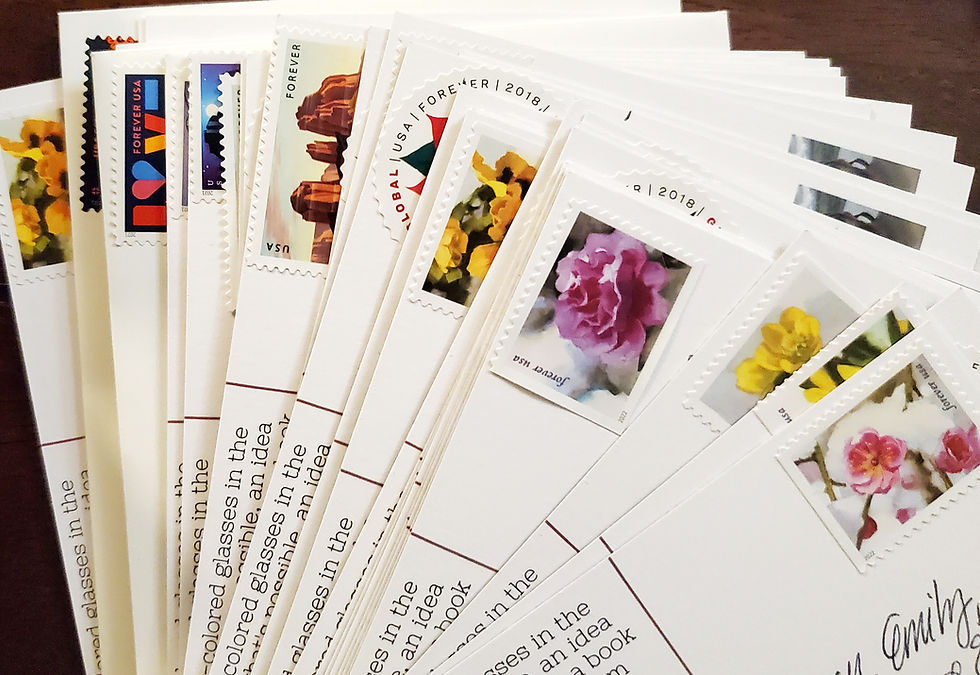
The history of Euro-American scientific writing intersects multiple times with longstanding traditions of writing letters for business, intellectual, and intimate purposes. In fact, many of our English-language academic journals today still use the term Letter in their title and/or as a type of manuscript they will consider for publication. And while much of my work, and my new book, centers on this sort of professional writing, I also work hard to remember that science and academia are only one part of my life.
So today, I want us to focus closely on the personal side of letter writing.
To that end, you might not be interested in the debate I’ve been having with myself—how long of a New Year’s letter should I write [1] to the loved ones and kin in my life!
However, you might be willing to debate with Emily Dickinson about whether a letter is the source of eternal youth. [2]
Either way, it’s possible that you, too, are feeling caught in a peculiar limbo this year. Certainly, this time of year fuels my ambivalence about how much to write, and to whom. I have a very conflicted relationship with Christmas dating back to my childhood; for various, additive reasons, the complicated dynamic persists even now. On top of that, this year feels especially fraught in the generosity and gratitude department.
So, I am (again) pondering (and seeking out a range of perspectives on) several related questions:
Whether to give holiday gifts, how, why, how much, and to whom, and who should do the giving;
Whether holiday cards and letters of any sort are their own distinct category of seasonal labor, and how to navigate all the associated implications, contradictions, and opportunities;
What it actually means to be in a gifting relationship with someone;
What reciprocity and a gift-based economy mean, what relational activities are, and whether holiday traditions like gifts or cards/letters can actually foster mutual care or just compel excess care work and consumerism and throw us back into toxic patterns;
What kinds of communicative practices actually do foster and sustain relationships, near and far.
I haven’t resolved these conundrums for myself. Certainly not this year. All those questions also relate to the broader dilemma of how to foster, sustain, and experience the depth of connections that we know we need for our well-being.
What I can tell you—which is why I’m writing about it to you today—is that writing and receiving cards and letters is one tried and true way I have found to address this need for enduring relationships [3] any time of the year.
***
I LOVE writing letters and notes (and yes, receiving them!). I grew up writing my grandmother in California, and I had all kinds of pen pals as a kid. I used to photocopy my favorite drawings from horse books, cut them out, tape them to blank paper, whiteout the edges, and re-photocopy, repeating the process until I had “clean” stationery that I could then fill up with dreams, ideas, updates, and questions for the people to whom I wrote.
Many of the items I send now still feature my own art. This year, I’ve also begun mailing collages I’ve made on postcards scavenged from a different grandmother’s trove. To this day, I send friends and family cards, postcards, letters, and little care packages whenever the whim strikes, all year long. I am also committed to thank you notes as a vehicle for sending more letters, both to friends/kin and to colleagues. I have a profound belief that writing and receiving personal mail is a vital part of our experience as literate humans. Much of the world’s knowledge has been documented and circulated as letters, and this act has sustained countless important relationships throughout history.
This year, I have also overtly encouraged people around me to write to the special people in their lives. For example, at my birthday bash early this fall, I had a station of stickers, markers, and stamps, and many old postcards for guests to modify and write a note to someone close to them. And for at least three years, I’ve been organizing friends and acquaintances to contribute to voter turnout postcard writing campaigns—I order the batches of postcards, then distribute to friends and we have writing parties.
When I tell people all this, they often react with aversion: '“that seems like so much time and effort.” Or, they become wistful: “oh, I wish I had the time to do that.” And, they say: “how do you know what to write?” Perhaps you feel similarly.
***
Here are my top 3 tips for sending letters/postcards as a way to stay connected:
Stamps are still wildly cheaper than buying gifts and shipping parcels, in the U.S., at least. And you only need one stamp to send even an international letter (if you don’t blow past the weight limits). So, take a few minutes to stop by the post office and stock up on stamps. If you have them handy, you have removed the first major hurdle. An addressed letter without a stamp can languish on a to-do pile for months!
Use absolutely anything to write upon and with. If you want to be inspired, write on beautiful or funny things. If you want to be frugal or environmentally friendly, re-use materials you have lying around. If you want to be artsy, make or decorate the paper you write upon. If you don’t like your handwriting or find handwriting difficult, type on a computer or typewriter. But, the important thing is to just write. Don’t get precious about it and end up not writing at all.
Write about what is genuinely happening in your life, what you are interested in, and/or questions you have about the other person. I usually start by saying something about the weather and/or a nature observation I’ve recently made. Maybe I’ll describe a nice meal we cooked, or an activity we recently did with friends. I might mention something I intend to do in the near future or describe an experience I had that made me think of them and our shared interests or history. Or, I’ll ask them to remind me of a favorite recipe of theirs, or to provide detail about a memory from our past. I’m not composing fine art writing, so I don’t worry about using perfect penmanship or wording. My lines are usually not very straight across the page, and I simply scribble out my frequent “typos.” I rarely include anything like a quote or anything that might seem “fancy” unless I am purposely writing to share a quote or idea with someone. If you’re still not sure what to say, imagine writing a note about something you might usually just text about! The stakes are very low here; let them be.
BONUS: Use a postcard or greeting card [4] at first, before or instead of using blank sheets of paper. There is a finite amount of space on a card, so you won’t feel like you have to keep writing and writing. That means you can dash off a note while you’re eating breakfast, say. And, if you’re not sure what to say, keep it brief and write big! (Of course, if you have lots to say, write small, so you can squeeze it all in, or add in a sheet or two of paper to make space for everything, if you really get rolling.)
***
In November, a third grandmother—the one I grew up just down the road from, gave me her remaining postcard stamps (several sheets). It was a bittersweet moment. She was one of my early models for someone who maintained a prolific correspondence (mostly one-way) with 25 grand kids, dozens and scores of relatives, and more, for probably 60-70 years. For her to give me her stamps was a clear acknowledgement that she will not be traveling any more, and thus will no longer be sending postcards. She wanted me to have the stamps because I send her postcards, both when I travel and just because. I’ll use her stamps to send her our holiday card, and to send the rest of my cards.
The lesson from my grandmothers—each of whom lived lives so different from mine, bound up in strictures and obligations of motherhood and earlier eras—is that meaningful connection can be fostered through letters. When I write now, I feel I also honor their individual decisions about how they maintained the relationships they decided mattered to them.
How about you?
Whatever your year-end and new year’s traditions are, how do you enact them in ways that foster and sustain connection and meaning in your relationships?
NOTES
[1] I’ve been debating for at least a week about whether to write a long (and I’m talking long) year-end/new year’s update letter. Ironically, perhaps, I already took the time philosopher Blaise Pascal did not and finessed a short note (revised and refined with input from my husband). Our succinct note has been printed on the ~150 postcards I’ll address and mail later this month, to serve as the annual New Year’s greeting I started sending some years back. But, this discussion thread got me thinking about all the very true things happening in our lives that can’t possibly fit on a postcard destined for a wide range of recipients. I haven’t yet decided if I’ll also write the longer missive, nor how I’ll share that with folks given that, over the years, I have pared down from sending cards with envelopes and photos to now sending just a postcard with a cheaper stamp. But it’s on my mind that a preprinted note, while still a touch point of connection, necessarily obscures a lot of honesty about our lives. And it is the regular, candid sharing of our lives that really sustains connections. So, maybe folks will get another postcard at some point, with a link to the longer letter. Or maybe I’ll write that letter just as a catharsis for myself. That’s for the future to know.
[2] That’s Dickinson I’m quoting in the title to this post.
[3] Certainly, living closer to people, being an active and regular part of their lives, making phone calls and/or soup, etc., also helps. But, in the absence of an ability to time travel, letters play a key role in the connective tissue of many of my relationships.
[4] You can, of course, spend a lot of time finding the “right card.” Doing so can be stressful (or fun!), and it can also feel expensive. So, my recommendation is to scavenge. I have found all sorts of absurd and lovely cards at secondhand stores and thrift shops. You could also mention to friends, or post an ISO on your local “buy nothing group”, that you’re looking for old cards and stationery others don’t use anymore. It really doesn’t matter what the card looks like (as long as it’s not offensive), because the point is that you’re sending a real letter at a time of year that does NOT require a specific card. (Now is not the time to fret about a perfectly worded birthday card, and the spirit of this kind of letter writing never requires that fretting.)


Comments